NPS working to improve student academic outcomes, systems of support | Select
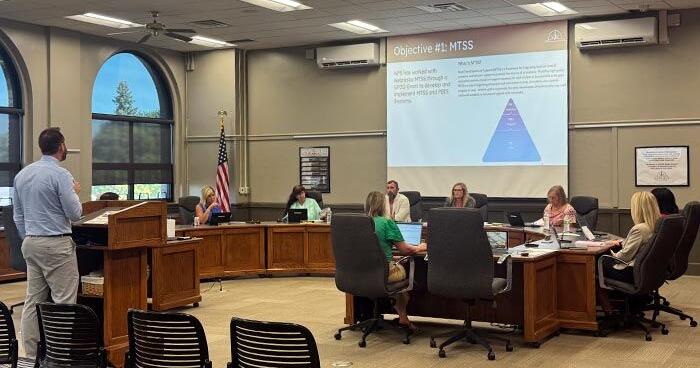
Norfolk Public Schools is making progress on its goals to improve academic achievement and student support systems.
At its Monday meeting, Jared Oswald, director of teaching and learning, walked board members through two goals from the district’s strategic action plan. Goal one aims for NPS to exceed the state average in all student achievement assessments by 2026, while goal five sets a 2027 deadline for implementing comprehensive behavioral, mental health and academic systems of support across the district.
“The teams that develop these goals believe that completion of goal five will be one of the most important factors in us meeting the goal that is set for goal one,” Oswald said.
To achieve goal five, the district is focused on three strategic objectives, the first of which involves developing academic supports through a multi-tiered system of support (MTSS). MTSS, Oswald explained, operates on a three-tiered model that targets support based on individual student needs, ranging from core instruction (tier one) to targeted interventions (tier two) and intensive individualized support (tier three).
MTSS implementation is strongest at the K-6 level, where student support teams meet every six weeks to assess and revise intervention strategies. At the secondary level, the process is less formal because of the complexity of student schedules but still occurs regularly through teacher collaboration and counselor outreach.
The second objective under goal five targets behavioral and mental health support through positive behavioral interventions and supports (PBIS). Oswald highlighted “check in, check out” as a widely used tier two intervention for K-8 students, helping build connections between students and trusted adults. At the high school level, a more flexible mentorship model called “check and connect” is in use.
While tier two supports are largely in place, Oswald noted that tier three interventions are still being developed. Over the summer, district teams worked with Nebraska MTSS consultants to begin building more intensive supports for students with complex needs.
The third strategic objective focuses on equipping staff to effectively implement these systems. Oswald credited the Nebraska MTSS program and a state personnel development grant (SPDG) for providing valuable training opportunities over the past three years.
In terms of academic achievement, Oswald shared that NPS has shown consistent growth in English language arts, math and science scores over the past three years, with fluctuations. While proficiency in math dipped slightly last year — from 59% to 56% — ELA scores remain above the state average, while math and science are just slightly below.
ACT scores also saw a minor decline in 2022-23, a trend Oswald said was consistent statewide and nationally. Scores improved slightly this past year, although NPS still lags behind peer districts in all tested areas.
Math remains as an area of focus.
“Probably the most behind the state in that area,” Oswald said, stressing the need for stronger instructional and support systems in the subject.
A communication plan is in place to share testing data with the public each October, once the state lifts its data embargo. Press releases are routinely issued, with local media outlets helping distribute the results.
When asked whether the state average should be viewed as a minimum benchmark or a loftier target, Oswald said he aims to set realistic yet ambitious goals.
“We’re always trying to get better,” he said, noting that refining goal-setting strategies remains a work in progress in his second year in the role.
link