FAIMA Survey Flags Deep Gaps in Medical Education, Mental Health of Medicos | Nagpur News
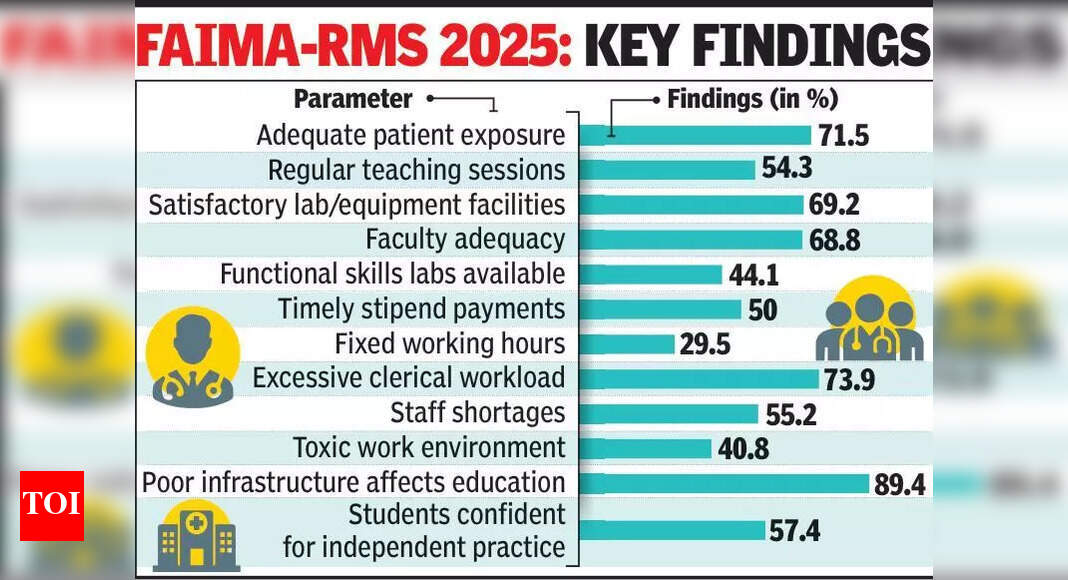
Nagpur: A nationwide survey by the Federation of All India Medical Association (FAIMA) has exposed serious gaps in India’s medical education system, flagging concerns over infrastructure, faculty strength, and the mental well-being of medical students and teachers.The FAIMA-Review Medical System (FAIMA-RMS) survey, released on Thursday, received over 2,000 responses from students, teachers, and professors across 28 states and union territories. The findings highlight worrying conditions in several newly established medical colleges, especially after the government’s recent move to increase MBBS and postgraduate seats by 5,000 each.“Medical students feel that while seat numbers have gone up, their core academic and welfare issues remain unresolved,” FAIMA National President Dr Akshay Dongardive told TOI.Conducted between September and October, the survey covered both government and private colleges — 90.4% from government institutions and 7.8% from private ones — offering a broad snapshot of India’s medical training landscape.As per the report, only 71.5% of respondents said they had adequate patient exposure, 54.3% reported regular teaching sessions, and 69.2% found lab and equipment facilities satisfactory. Around 68.8% rated faculty adequacy as acceptable, but just 44.1% confirmed the presence of functional skills labs.Administrative and financial concerns were equally pressing. Only half said they received stipends on time, and just 29.5% reported fixed working hours. Nearly 74% complained of excessive clerical work, 55.2% cited staff shortages, and 40.8% described their work environment as toxic. Almost 90% felt poor infrastructure directly affected the quality of medical education.“This data indicates that numerous students and medical professionals face acute mental stress,” said Dr Sajal Bansal, Chief Advisor, FAIMA, adding that even doctors from remote regions such as the Andaman and Nicobar Islands participated in the study.Private colleges performed marginally better in teaching regularity and faculty availability, while government colleges offered higher patient exposure but heavier administrative loads. Though 70.4% of respondents expressed moderate confidence in their skills, only 57.4% felt ready for independent practice — underlining the gap between theoretical knowledge and clinical readiness.FAIMA noted that a National Task Force in 2024 had issued recommendations following a similar survey among undergraduates, postgraduates, and teachers. These included fixed duty hours, mental-health counsellors, annual parent-interaction sessions, and 10 days of wellness leave. However, most measures remain unimplemented.The association urged the Ministry of Health & Family Welfare and the National Medical Commission (NMC) to act swiftly. “We will submit detailed recommendations to NMC and NITI Aayog for reforms that ensure mental and academic well-being of medicos,” said Dr Dongardive.FAIMA also expressed concern that despite repeated efforts, its representatives were unable to meet NMC officials, including the chairman, to present their suggestions.The survey was conducted under the guidance of Patrons Dr Rohan Krishnan and Dr Sandeep Dagar, Chairman Dr Manish Jangra, and President Dr Akshay Dongardive. Dr Sajal Bansal served as Chief Coordinator, supported by Co-Chairmen Dr Jaideep Choudhary, Dr Shrinath, Dr Sushil Shinde, and members of Resident Doctors’ Associations nationwide.FAIMA-RMS 2025: Key FindingsParameter | FindingsAdequate patient exposure | 71.5Regular teaching sessions | 54.3Satisfactory lab/equipment facilities | 69.2Faculty adequacy | 68.8Functional skills labs available | 44.1Timely stipend payments | 50.0Fixed working hours | 29.5Excessive clerical workload | 73.9Staff shortages | 55.2Toxic work environment | 40.8Poor infrastructure affects education | 89.4Students confident for independent practice | 57.4(Findings in %)
link