


The university stage is a critical period for personal growth and development, during which students not only acquire specialized knowledge but also cultivate critical thinking and proactive exploration skills, laying a foundation for their future careers and lifelong learning1. College students face complex physiological and psychological developmental challenges, making the promotion of their healthy growth a key focus of higher education research2. As they navigate this important transitional phase, students must cope with pressures from academics, career development, and social interactions, underscoring the essential role of teachers’ support in this process3,4.
Learning engagement, as a key factor influencing college students’ academic achievement and personal development, has long been a focal point in higher education research5. Learning engagement not only directly affects academic performance but is also closely tied to students’ mental well-being and future development6. High-quality engagement enhances students’ learning satisfaction, promotes deeper understanding of knowledge, and fosters a lifelong learning mindset7. In recent years, with increasing attention on students’ holiFstic development, the concept of learning engagement has expanded to encompass not only cognitive involvement but also emotional and behavioral participation8. Research has shown that learning engagement depends not only on the content and format of instruction but also on various factors such as teachers’ emotional support9. Teachers’ emotional support, defined as the care, understanding, and encouragement provided to students during the learning process, has been widely recognized as a key factor in enhancing students’ positive engagement10. While most existing research has examined the impact of teachers’ emotional support in primary and secondary education, relatively little is known about how it specifically enhances learning engagement among college students, who often demonstrate higher levels of self-directed learning11. Furthermore, although theoretical frameworks emphasize the importance of teachers’ emotional support, empirical studies have yet to thoroughly investigate its mechanisms, particularly in the context of higher education12. In this regard, a critical gap exists in understanding how internal psychological factors mediate the relationship between teachers’ emotional support and learning engagement.
Academic self-efficacy and academic resilience have been identified as key psychological factors influencing students’ learning behaviors and outcomes. Academic self-efficacy, which refers to students’ confidence in their ability to complete academic tasks successfully, directly influences their motivation, persistence, and engagement in learning13. Meanwhile, academic resilience enables students to adapt and maintain a positive attitude when facing academic challenges, supporting sustained engagement and effort14. While these constructs are often studied independently, their combined mediating roles in the relationship between teachers’ emotional support and learning engagement remain under explored15. Self-efficacy reflects students’ belief in their ability to achieve future goals, whereas resilience represents their capacity to cope with present difficulties. Together, these factors provide complementary perspectives on how students respond to external support.
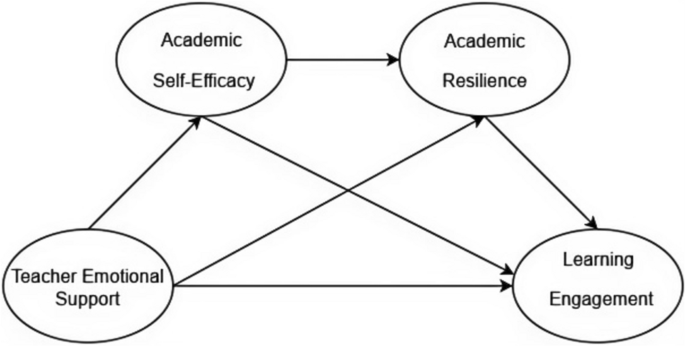
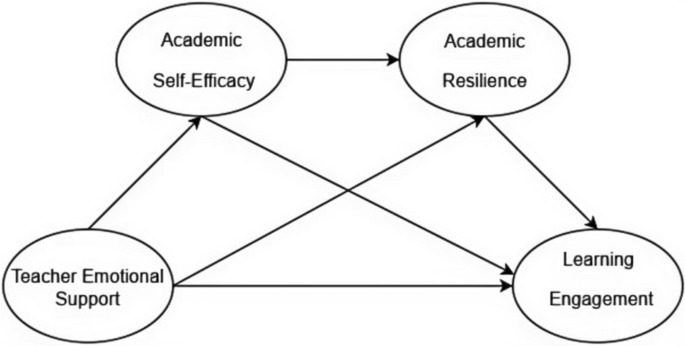
The theoretical significance of integrating academic self-efficacy and academic resilience lies in their ability to illuminate the multiple pathways through which teachers’ emotional support enhances learning engagement. Teachers’ emotional support may strengthen self-efficacy by boosting students’ confidence in their academic abilities and foster resilience by equipping them with the emotional stability and coping mechanisms needed to navigate academic challenges. Understanding these interactions can provide a more nuanced explanation of how teachers’ support shapes students’ learning experiences. In light of this, the present study aims to explore the impact of teachers’ emotional support on college students’ learning engagement, with a particular focus on the mediating roles of academic self-efficacy and academic resilience. Through empirical analysis, this research seeks to reveal how emotional support enhances students’ confidence and resilience, thereby promoting sustained engagement. The findings aim to contribute to the theoretical foundation of higher education practice, helping educators better understand the critical role of emotional support in teaching. Ultimately, this understanding can inform the optimization of teaching strategies to improve students’ learning experiences and academic outcomes.
Teacher emotional support
Teachers’ emotional support is defined as an educational practice in which teachers foster positive teacher-student relationships, provide emotional care and constructive feedback, and address students’ individual needs16. By creating a psychologically safe and supportive classroom environment, this form of support enables students to feel valued, understood, and respected. Such an environment not only enhances students’ ability to concentrate on academic tasks but also equips them with the emotional and psychological resilience needed to overcome academic challenges effectively17. Research indicates that teachers’ emotional support plays a pivotal role in promoting students’ academic and emotional development. By addressing students’ fundamental psychological needs, including relatedness, competence, and autonomy, this support contributes to improved academic performance and fosters overall psychological well-being18.
Self-efficacy refers to an individual’s belief and confidence in their ability to successfully complete a specific task or achieve a goal19. Academic self-efficacy is the student’s subjective judgment and belief in their ability to accomplish academic tasks. Numerous studies have shown a close relationship between students’ academic self-efficacy and their academic performance20. Research has consistently demonstrated that teachers’ emotional support serves as a crucial external factor in fostering students’ self-efficacy. By offering positive emotional reinforcement, teachers can help students develop confidence in their own abilities21. Furthermore, studies have highlighted that teachers’ emotional support, delivered through clear and constructive feedback as well as encouraging communication, enables students to form a more positive perception of their academic capabilities, thereby enhancing their self-efficacy22. For instance, in secondary education, students who perceive their teachers as caring and supportive often exhibit greater confidence in their ability to successfully complete academic tasks. This increased confidence, in turn, motivates them to exert more effort in their studies23.
Academic resilience is defined as students’ ability to demonstrate persistence and adaptability in the face of academic challenges and setbacks24. This capability not only enables students to overcome academic difficulties but also plays a vital role in supporting their long-term academic success25. Recent research has increasingly emphasized teachers’ emotional support as a critical factor in nurturing and strengthening students’ academic resilience26. Teachers’ emotional support helps students maintain a positive emotional state and develop coping strategies when facing setbacks by addressing their psychological needs27. For example, in primary education, teachers who encourage and recognize students’ efforts can enhance their ability to recover from failure, thereby improving their performance in subsequent tasks28. Among college students, teachers’ emotional support has been found to alleviate academic stress and strengthen students’ ability to cope with high-intensity academic demands29. Furthermore, by fostering supportive teacher-student relationships, teachers’ emotional support encourages students to seek help when encountering difficulties, which further enhances their resilience30.
In conclusion, teachers’ emotional support is far more than an abstract concept; it is a transformative force in shaping educational outcomes. By cultivating self-efficacy and fostering resilience, teachers play an essential role in guiding students’ academic and emotional development. As education continues to face increasingly complex challenges, the critical importance of teachers’ emotional support remains undeniable, serving as a cornerstone for student success in both learning and life.
Learning engagement
Learning engagement refers to the active participation and effort students demonstrate in behavioral, emotional, and cognitive aspects during the learning process31. The literature highlights that learning engagement is shaped by a combination of internal and external factors, with teachers’ emotional support playing a particularly influential role as part of the external environment32. Teachers’ emotional support fosters a positive classroom atmosphere, encouraging greater behavioral participation from students. Furthermore, it strengthens students’ intrinsic motivation, enabling deeper cognitive engagement with learning activities33.
In addition to teachers’ emotional support, learning engagement is also influenced by students’ individual psychological traits, with academic self-efficacy being one of the most extensively studied variables. Research indicates that students with higher self-efficacy are more likely to exhibit stronger behavioral engagement and cognitive effort, as they believe in their ability to tackle academic challenges34. In online learning environments, self-efficacy has been shown to predict students’ levels of participation, with higher self-efficacy being closely associated with greater course engagement and improved learning outcomes35. Similarly, in blended synchronous learning environments, self-efficacy directly influences the depth of students’ cognitive engagement and their willingness to take on complex learning tasks36.
Academic resilience has also been recognized as a critical internal factor in fostering learning engagement, particularly when students encounter challenging academic tasks or prolonged difficulties37. Students with high levels of resilience are better equipped to regulate their emotions and adapt their strategies in response to obstacles, enabling them to stay engaged in their learning without losing confidence or abandoning their goals due to temporary setbacks8.
Research suggests a strong connection between academic resilience and self-efficacy, though they serve distinct purposes. Self-efficacy reflects students’ confidence in their ability to succeed academically in the future, while academic resilience represents their ability to navigate and overcome current challenges15. Together, these two traits can complement one another in fostering learning engagement. For example, students with high self-efficacy may be more likely to engage actively in their studies, but without resilience, they might struggle to stay motivated when setbacks occur. Conversely, highly resilient students may persist in the face of difficulties, but without a strong belief in their abilities, they may lack the confidence to set ambitious goals or complete tasks effectively 38.
Therefore, examining self-efficacy and academic resilience together offers a more comprehensive perspective on how teachers’ emotional support can enhance learning engagement through multiple pathways. This exploration of a dual mediating mechanism not only addresses gaps in the existing literature but also provides valuable insights into students’ learning behaviors, offering a fresh lens through which to understand and support their academic development.
Self-determination theory
Self-Determination Theory (SDT) is an effective theoretical framework for examining the complex relationship between environment, individual motivation, and behavior, applicable to various contexts, including education. SDT posits that social factors influence individuals’ motivated behaviors through their sense of autonomy or control experienced within their environment39. Self-determined motivation in students is influenced by how well their environment meets their three fundamental psychological needs: autonomy, relatedness, and competence. The more these needs are satisfied, the stronger their intrinsic motivation becomes40. The more these needs are met within a supportive educational environment, the higher the learners’ autonomous motivation. This, in turn, fosters more positive motivational states, including maintaining higher self-efficacy, stronger academic resilience, and increased learning engagement, ultimately promoting academic achievement.
Although existing studies have explored the impact of teacher support on learning engagement, most have been limited to examining direct relationships between individual variables, with insufficient attention given to sequential mediation mechanisms. Thus, it is necessary to re-examine this issue in the context of blended learning, analyzing it from multiple perspectives by incorporating variables such as academic self-efficacy and academic resilience to comprehensively investigate the actual effect of teacher emotional support on learning engagement. Moreover, the lack of in-depth analysis of underlying mechanisms has made it challenging to effectively address the issue of college students’ learning engagement. This study, grounded in the framework of Self-Determination Theory, aims to explore how teacher emotional support influences learning engagement. Understanding the impact of teacher emotional support on students’ self-efficacy and resilience provides valuable insights into their learning engagement. From a practical perspective, our findings suggest that supportive environments should be cultivated in schools, paying close attention to students’ psychological needs while enhancing their learning engagement. Therefore, this study investigates the relationship between teacher emotional support and college students’ learning engagement, testing the following hypotheses:
H1: Teacher emotional support significantly and positively predicts learning engagement.
H2: Academic self-efficacy mediates the relationship between teacher emotional support and learning engagement.
H3: Academic resilience mediates the relationship between teacher emotional support and learning engagement.
H4: Academic self-efficacy and academic resilience function as sequential mediators in the relationship between teacher emotional support and learning engagement (Fig. 1).

link