USD 383 candidates discuss technology, school safety and special education at forum | News
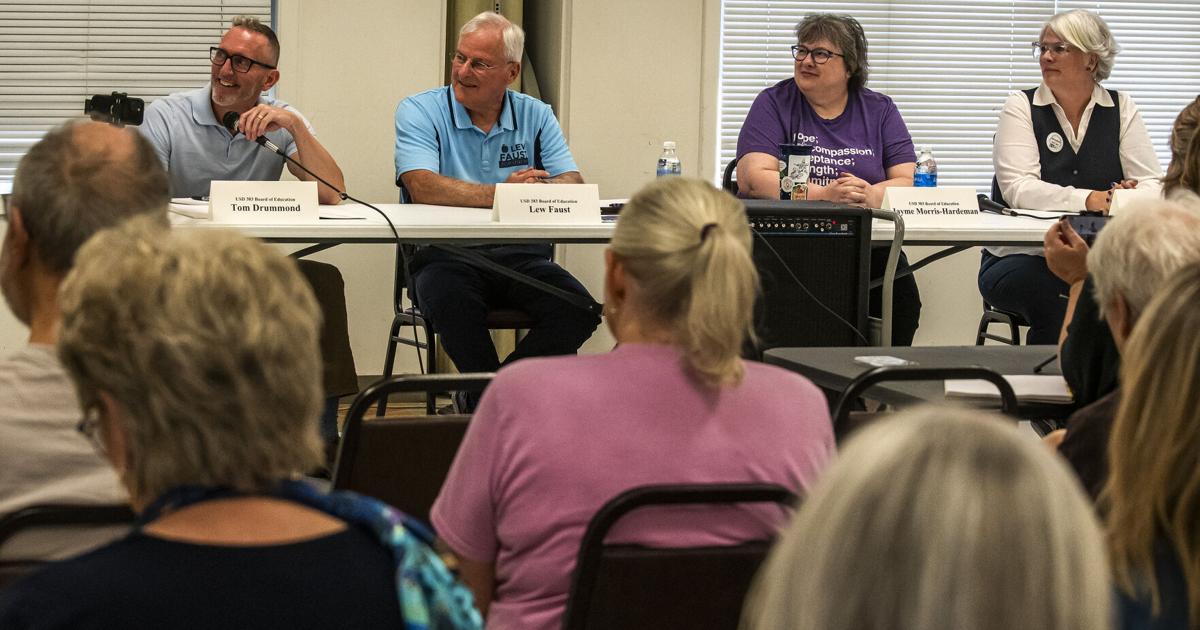
USD 383 school district candidates on Tuesday talked about school safety, special education and digital citizenship in the era of screens and artificial intelligence.
Four candidates vying for election or re-election to the Manhattan-Ogden school board gave their stances on issues facing students and educators at the Manhattan Senior Center. One candidate, Leah McKeeman, was absent.
The Flint Hills Wellness Coalition and the Riley County Council of Social Services Agencies organized the forum with the senior center.
On the topic of artificial intelligence and the role of technology in education, candidates acknowledged its part of the world as a tool, as well as its risks.
“I think all of our schools and teachers should introduce technology and discuss technology as a tool, because that’s what it’s meant to be,” candidate Courtney Hochman said. “And so our students need to learn certain skills to be good citizens, to be responsible humans, to function with the technology that exists in our world but that should not be without guardrails.”
Hochman said students need to learn how to identify what is real and AI-generated because of how convincing it can be.
“Technology is amazing, AI is amazing, quantum computing is amazing but those should be tools that are used to enhance and accelerate already-present skills in the student, not be a replacement for them,” candidate Tom Drummond said. “I’m so glad they have the new screen time thing, the tech policy in place.”
Drummond said it is important that children develop human connections, which a screen addiction can take away.
Regarding school safety measures and the prevention of violent attacks in schools, the candidates agreed it is an issue of mental health and culture within the community.
“I don’t know what we can do to address gun violence besides address mental health and the guns,” said incumbent board member Jayme Morris-Hardeman. “We need to limit the number of guns and who has access to them and we need to address mental health issues.”
Drummond said the focus should not be solely on the weapon itself but getting to the root of the problem.
“When I hear these questions about guns and weapons, the immediate focus is on the material weapon, the gun,” Drummond said. “I agree with the panel, it should start with the mental health. How do you increase mental health, how do you improve the child’s outlook and hope and sense of love for the world and the fellow students? It starts at home.”
Drummond said the family unit, how children are treated at home and relationships with their parents is where solutions start.
“It’s hard to know what to look for,” Hochman said. “My father used to tell me, ‘Locks only keep law-abiding citizens out, so in a way, that’s it. If a student wants to bring a gun to school, they’re going to. I don’t think we’re in a community at a level of concern where we will need metal detectors to get into schools. That just makes another hiccup of getting into the building.”
On the issue of supporting students with Individualized Education Programs, or IEPs, candidates discussed the need for paraprofessionals and more funding from the state for special education.
“I think right now we have an outstanding special education program in our district, but that doesn’t mean we’re meeting the needs of every kid,” Morris-Hardeman said. “Not every child with an IEP is receiving the services they need, and that’s a funding issue. We don’t have enough paraprofessionals in our classrooms.”
Morris-Hardeman said if USD 383 had more funding from the state, it could afford to hire more paraprofessionals.
“If we had $4 million extra dollars, how many more people could we hire into our buildings to work with our students,” Morris-Hardeman said. “All students, but particularly with students with special needs.”
One of the candidates, Lew Faust, has experience in the world of special education. He has a son with autism who graduated from Manhattan High School.
“The challenges with special education, one of them comes from paraprofessionals, sometimes it comes from staffing and it’s due to a lack of funding,” Faust said. “The state is supposed to fund that 93% of excess costs and right now it’s somewhere down around 70%. The state hasn’t fully funded special education since 2011.”
Faust said to make up for less state funding, the district has to transfer millions of dollars from the general fund and local fund to supplement special education.
“That’s fine, those kids need the services,” Faust said. “Implementing the IEP and providing the support and the quality of the instructor is the key to success.”
link